


We’re making a slightly unexpected return to animation cycles this week as I revisit animating a hand wave. I sort of eluded to this motion in my arms crossed post, and this animation is a whole lot more simple. But that being said, there’s still a little bit of complexity here. And also there’s some animation terms and principles to briefly cover! Here’s the motion:
When it comes to animation principles, the focus here is mostly on overlap and arcs.
Overlap is the idea that different parts of the subject will move at different rates. In this animation, it happens with each segment of the arm. The shoulder moves and the upper arm follows closely. The forearm follows the upper arm but with significantly more delay. The hand does the same with the forearm, but with even more delay.
Arcs! Objects in motion usually follow some sort of arc. Think of the swinging of a pendulum. The arm does a similar motion when waving, but swinging upwards instead of downwards. While keeping these ideas in mind, I animated the arm/hand waving with the amazing Aang Rig. This rig, like most animation rigs, allows you to manipulate the character’s arms in either FK or IK configurations.
FK stands for Forward Kinematics. At its most basic, it’s a chain of joints in which each joint has influence over those lower on the chain. For an arm, this means that moving the shoulder will move the elbow, wrist, and fingers. Moving the elbow will only move the wrist, and fingers. And so on down the chain.
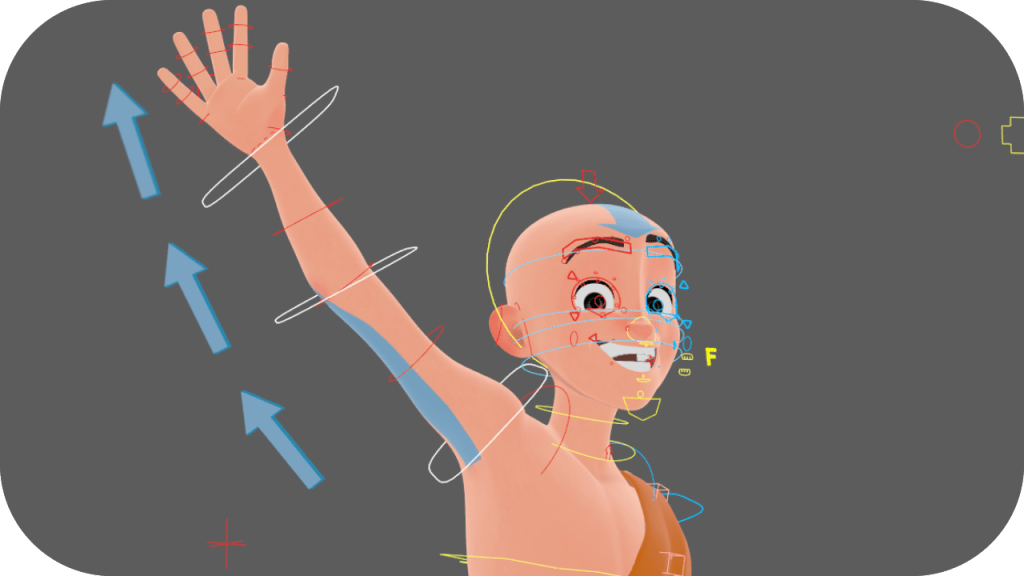
IK stands for Inverse Kinematics. As the name implies, this is an inverted system. With IK (and a whole lot of math) the joints lower on the chain actually have influence over those higher up the chain. It’s a lot more complicated than that, but when it comes to animation, that’s really all you need to know. With a character rig, an IK arm is usually manipulated via three controls. There’s the wrist control which allows you to translate the hand anywhere in space. This is the main control you use. There’s also the shoulder control, which allows you to rotate or translate the shoulder. Simple enough! But then there’s the mystical elbow control. This allows you control the angle/direction of the elbow. But here, it’s in relation to the positions of the shoulder and wrist controls (and again…a whole lot of math).
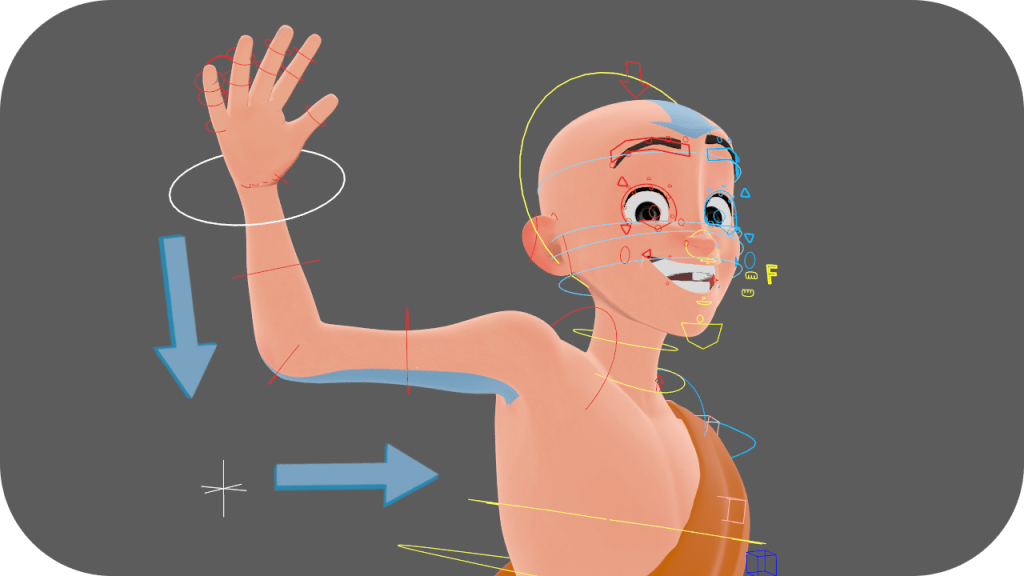
There are very specific situations in which you use FK verses IK, especially when it comes to the arms. At its most basic, FK is usually for arcs and sweeping motions. IK is usually for more precise movement of the hands or contact with other objects. I’ll cover IK a bit more later, but for this waving animation, the FK control scheme was ideal.
Like I mentioned before, overlap was an important animation principle to focus on with this hand wave. Because each segment of the arm needs to be following the others, with delay, you can see how FK fits the bill. The forward joint hierarchy is perfect for this, and it allowed me to create some decent overlapping motion. And on top of that, some good arcs too!
Next week we’re focusing a bit more on acting and object contact with a drinking animation! Thanks for reading!
Aang Rig by Mia Pray, Sagar Arun, and Rijah Kazuo
My Links: ArtStation / Instagram / Vimeo / YouTube


 Nick Kinteris
Leave a comment